

Lord Byron: A Romantic and Rebellious Poet
Lord Byron, one of the most celebrated poets of the Romantic movement, captivated readers with his rebellious passion and melancholic style. Works such as Childe Harold’s Pilgrimage and Don Juan challenged social norms and explored themes of freedom, love, and tragedy. Byron embodied the Romantic spirit, influencing generations of writers and artists who followed. His tumultuous life and his commitment to the Greek cause against the Ottoman Empire made him a legendary figure. Through his poetry, Byron transcended borders, leaving an enduring legacy that continues to inspire the imagination and creativity of modern literature and culture.
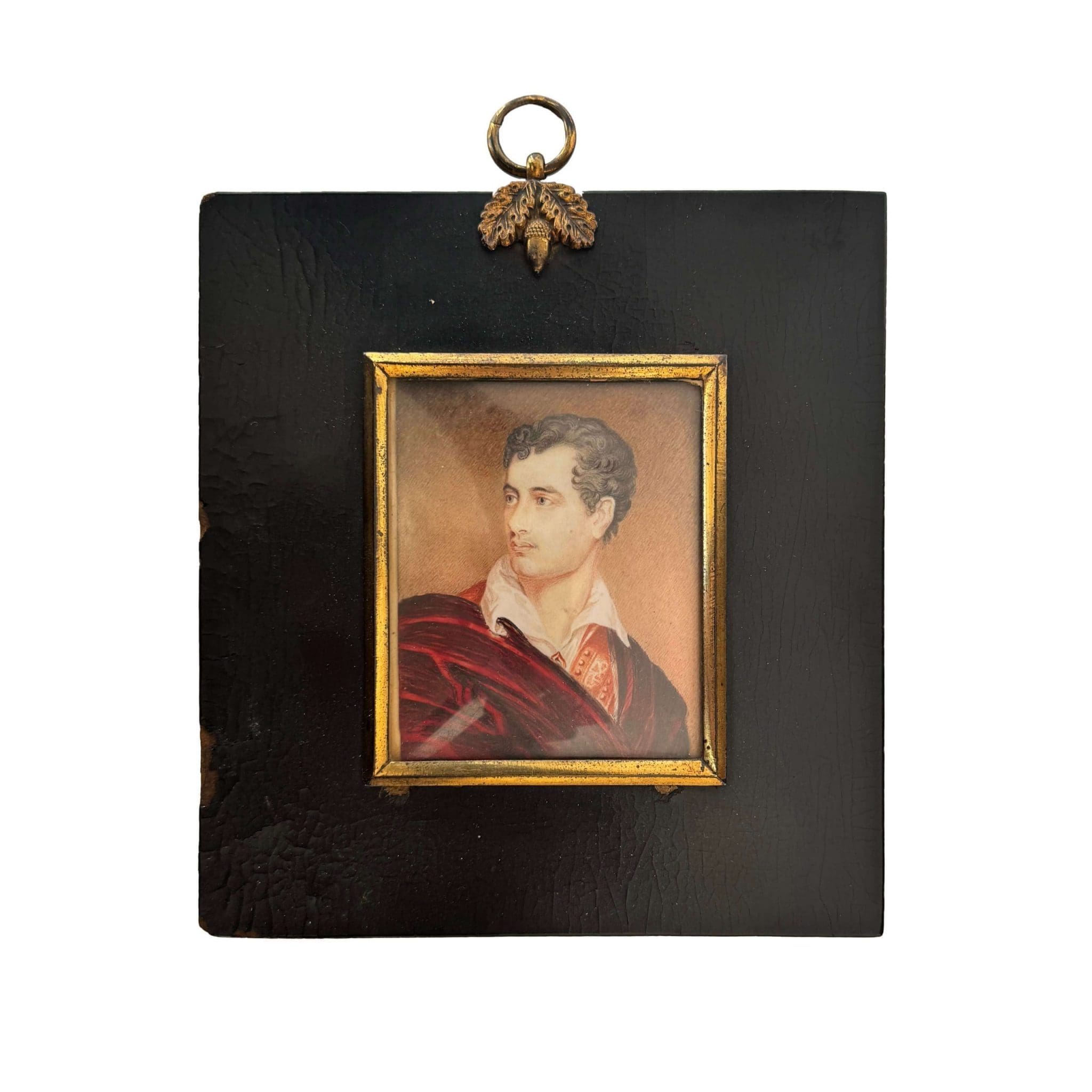
Below is a portrait of Lord Byron painted by H.J. Harding in the 19th century, available at DUSCAE:
Lord Byron, born George Gordon Byron on 22 January 1788 in London, was an emblematic figure of English Romanticism. Fatherless from an early age, he grew up in Scotland with his mother before inheriting the title of Baron Byron at the age of ten. He attended Harrow School and later Trinity College, Cambridge, where he began writing poetry. He was known for his numerous love affairs and his turbulent marriage to Anne Isabella Milbanke. His support for Greek independence led him to join the struggle for the country’s freedom. On 19 April 1824, he died of rheumatic fever in Missolonghi, aged 36.
Byron’s literary legacy is beyond question. Works such as Childe Harold’s Pilgrimage and Don Juan have established him as one of the most important poets of his time. His unique poetic style and his passion for freedom continue to inspire writers and artists to this day. The impact he has left on Western literature and culture is undeniable. Byron personified the Romantic spirit of his age, and his passionate life continues to fascinate those who seek to understand the complexity of the human soul — as well as his eternal search for truth and beauty.
The Works of Lord Byron
The work of Lord Byron, iconic within the Romantic movement, is an amalgam of passion, rebellion, and lyrical beauty. His masterpiece Childe Harold’s Pilgrimage — an epic poem recounting the travels of a young man through Europe and the Near East — established him as a leading voice of his generation. With vivid imagery and a melancholic sensibility, Byron transported readers to exotic landscapes and ancient ruins. Another of his outstanding works is Don Juan, an epic satire recounting the amorous adventures of the legendary seducer. With an irreverent tone and an agile prose style, Byron challenges the moral conventions of his time and satirises the hypocrisy of aristocratic society. Beyond his poetry, Byron also ventured into prose with works such as The Corsair and The Prisoner of Chillon, exploring themes of heroism, sacrifice, and redemption set against exotic and thrilling backdrops.
Byron’s work is imbued with a profound sense of freedom and passion, reflecting his own turbulent life and his belief in the transformative power of art. His unique poetic style is characterised by a masterful command of language; his capacity to evoke vivid images and intense emotions has made him one of the most influential poets of all time.
Although his life was brief, his legacy endures in modern literature and culture. He inspired the Romantic spirit in generations of artists, challenging the social and moral conventions of his era through both his life and his work. His influence extends far beyond literature, leaving an indelible mark on music, cinema, and popular culture. Through his verses, Byron expressed the deepest longings of the human soul, exploring the complexity of love and the individual’s struggle against the forces of fate. His legacy endures as a beacon of inspiration for those who seek truth and beauty in a world filled with passion and contradiction.
At DUSCAE, you can find the work Portrait of Lord Byron by the 19th-century artist H.J. Harding. It is a painting distinguished by its delicate technique, capturing the essence of the iconic Romantic poet. The portrait offers a window into Byron’s inner world, reflecting his passionate and melancholic character. It is a work that captivates through its emotional depth and technical skill, reminding us of Byron’s enduring legacy in literature and culture.

 No products in the cart.