

From Duscae — Cabinet of Curiosities, we have prepared this article to give context to what we seek to be today: a chamber of rare and collectible objects. An idea that has been transforming over the centuries, manifesting in many different forms.
Cabinets of curiosities, also known as chambers of wonders or cabinets of rarities, were an essential element in the history of art and collecting. They emerged during the Renaissance in Europe and served as the precursors of contemporary museums. These enigmatic collections reflected the human desire for exploration, discovery, and an understanding of the vast world that surrounded their owners.
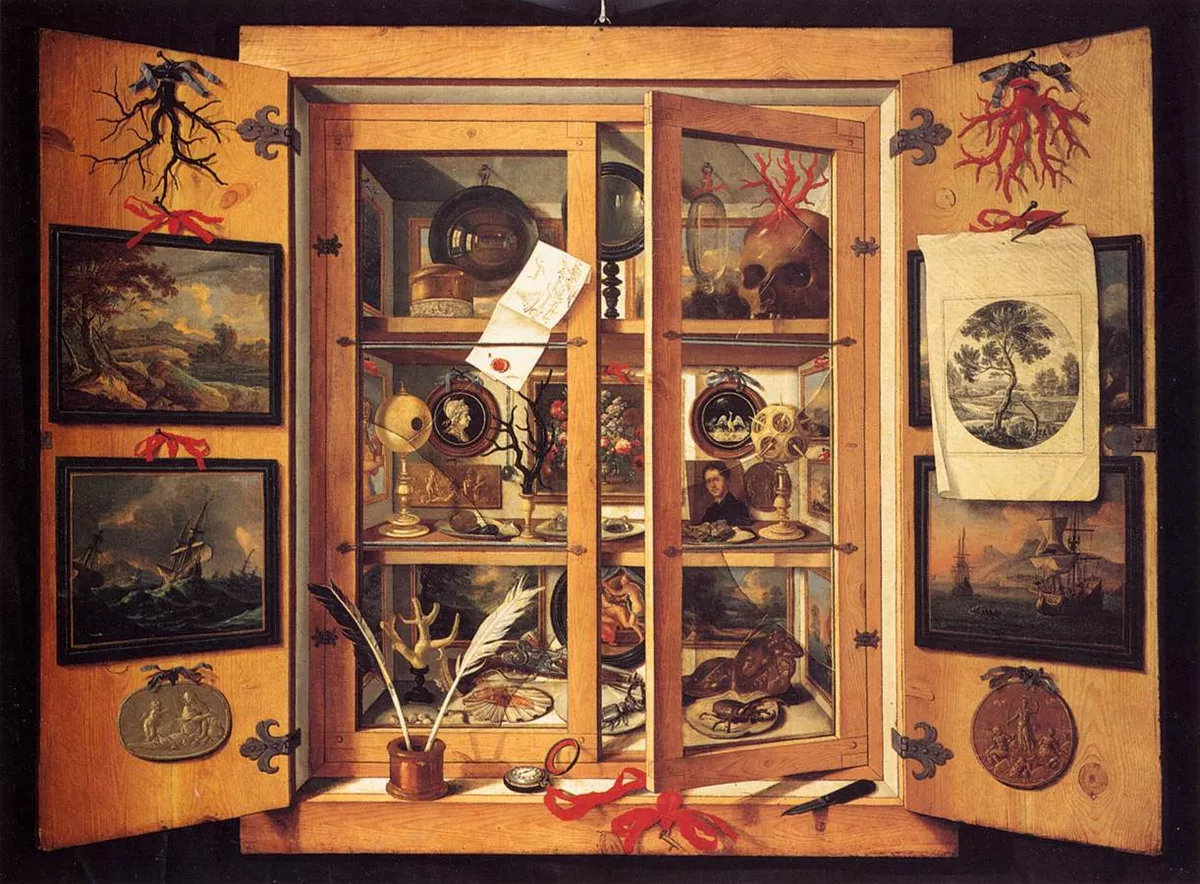
Domenico Remo, Cabinet of Curiosities, c. 1690. Image via Wikimedia Commons.
The Renaissance: An Age of Exploration
During the Renaissance — a period characterised by a fervent interest in knowledge and exploration — cabinets of curiosities began to take shape in the 16th century, as European collectors started assembling a wide variety of objects: ancient and natural artefacts, exotic rarities from other cultures and regions of the world.
These collections were remarkably varied and could include everything from sea shells and fossils to works of art, scientific instruments, religious objects, and anatomical curiosities. Collectors often displayed these objects in special rooms within their homes, where they would invite friends and scholars to admire and debate the wonders of nature and human creativity.
Over the centuries, cabinets of curiosities evolved and expanded, particularly during the 17th century, when global trade and voyages of exploration brought ever greater quantities of exotic and extraordinary objects to Europe. European monarchs and nobles began to compete with one another to create the most impressive and comprehensive collections, which led to the construction of dedicated spaces and the growing professionalisation of collecting. Throughout history, several of these cabinets achieved worldwide renown for the extravagance of their collections or the importance of their owners. Below are some notable examples:
1. The Cabinet of Curiosities of Rudolf II
One of the most famous cabinets of curiosities was that created by Emperor Rudolf II of Habsburg in Prague in the 16th century. It housed an impressive collection of art, natural objects, and rarities from every corner of the world. Beyond serving as a place of entertainment and learning, cabinets of curiosities also functioned as symbols of status and power, reflecting the wealth and prestige of their owners.
2. The Cabinet of Ole Worm
Ole Worm, a celebrated Danish physician and naturalist of the 17th century, owned a cabinet housing a diverse collection of rare and curious objects, including archaeological remains, natural specimens, and cultural artefacts. His cabinet, known as the “Museo Wormiano,” was one of the most famous of its era and served as an inspiration for other collectors.
Frontispiece of Ole Worm’s cabinet of curiosities from the ‘Musaeum Wormianum’, published in 1655.
3. The Cabinet of Curiosities of Peter the Great
Tsar Peter I of Russia, also known as Peter the Great, was an avid collector and the founder of the Museum of Anthropology and Ethnography in Saint Petersburg. His collection included objects from around the world — European art, Asian art, and pieces from indigenous cultures of North and South America. The cabinet of Peter the Great was one of the largest and most eclectic collections of its time.
4. The Cabinet of Ole Bull
Ole Bull, a virtuoso Norwegian violinist of the 19th century, kept a cabinet at his home on the island of Lysøen that housed a unique collection of art and exotic objects. Bull was passionate about culture and art, and his cabinet reflected his love for the extraordinary and the beautiful.
5. The Cabinet of Rarities of Sir Hans Sloane
Sir Hans Sloane, a British physician, naturalist, and collector of the 18th century, assembled a vast collection of art, books, natural specimens, and cultural artefacts from around the world. His collection served as the foundation for the establishment of the British Museum in 1753, making it one of the most influential cabinets of curiosities in history.
The Decline and Legacy of Cabinets of Curiosities
As the 18th century progressed, cabinets of curiosities began to fall out of fashion, and many were dismantled or transformed into public museums. Yet their legacy endured, and their influence can be seen in the creation of modern museums and in the way we continue to collect and display objects today. Contemporary artists have drawn inspiration from these ancient cabinets, creating modern reinterpretations that reflect the diversity of the contemporary world and address themes such as cultural identity, the environment, and technology. Artists use a wide range of media — from sculpture and painting to multimedia installations — to explore the concept of curiosity and wonder.
Museums and art galleries have also adopted the aesthetic of cabinets of curiosities in the presentation of exhibitions and collections, employing innovative designs juxtaposed with historical elements to create immersive experiences that invite the viewer to explore and discover.
Cabinets of rarities remain relevant in the world of contemporary art, serving as a source of inspiration for artists and as a means of creating connections between the past and the present. Their capacity to awaken curiosity and wonder is as powerful today as it was in the time of the Renaissance.
At DUSCAE — Cabinet of Curiosities, we have an exceptional catalogue of unique and limited-edition pieces. Visit it and find the wonders you are looking for.
 No products in the cart.