

The Trobriand Islands: Malinowski’s World
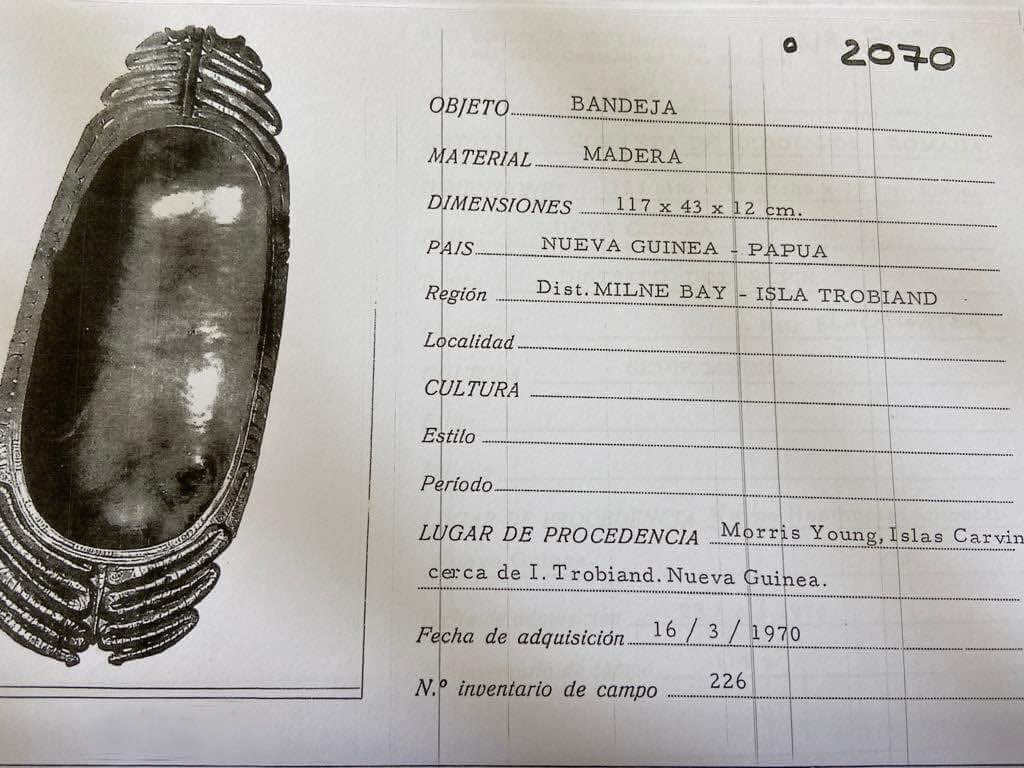
Few places in the world have been as consequential for the development of modern anthropology as the Trobriand Islands, a small coral archipelago lying east of the New Guinea mainland in the Solomon Sea. It was here, between 1915 and 1918, that Bronisław Malinowski conducted the fieldwork that would produce Argonauts of the Western Pacific (1922) and transform the practice of ethnographic research. Malinowski lived with the Trobriand people — the Kiriwina — through multiple seasons, learning their language and documenting the kula ring: the great inter-island ceremonial exchange network through which shell armlets and necklaces circulated in fixed directions around a ring of island communities, binding their participants in webs of obligation, prestige, and alliance. The wooden objects that Trobriand carvers produced for exchange and feast were integral to this system. A tray or food bowl was not merely a container — it was an argument about status, carved to demonstrate the skill of its maker and the wealth of those who commissioned it.
Carving as Language: Trobriand Decorative Conventions
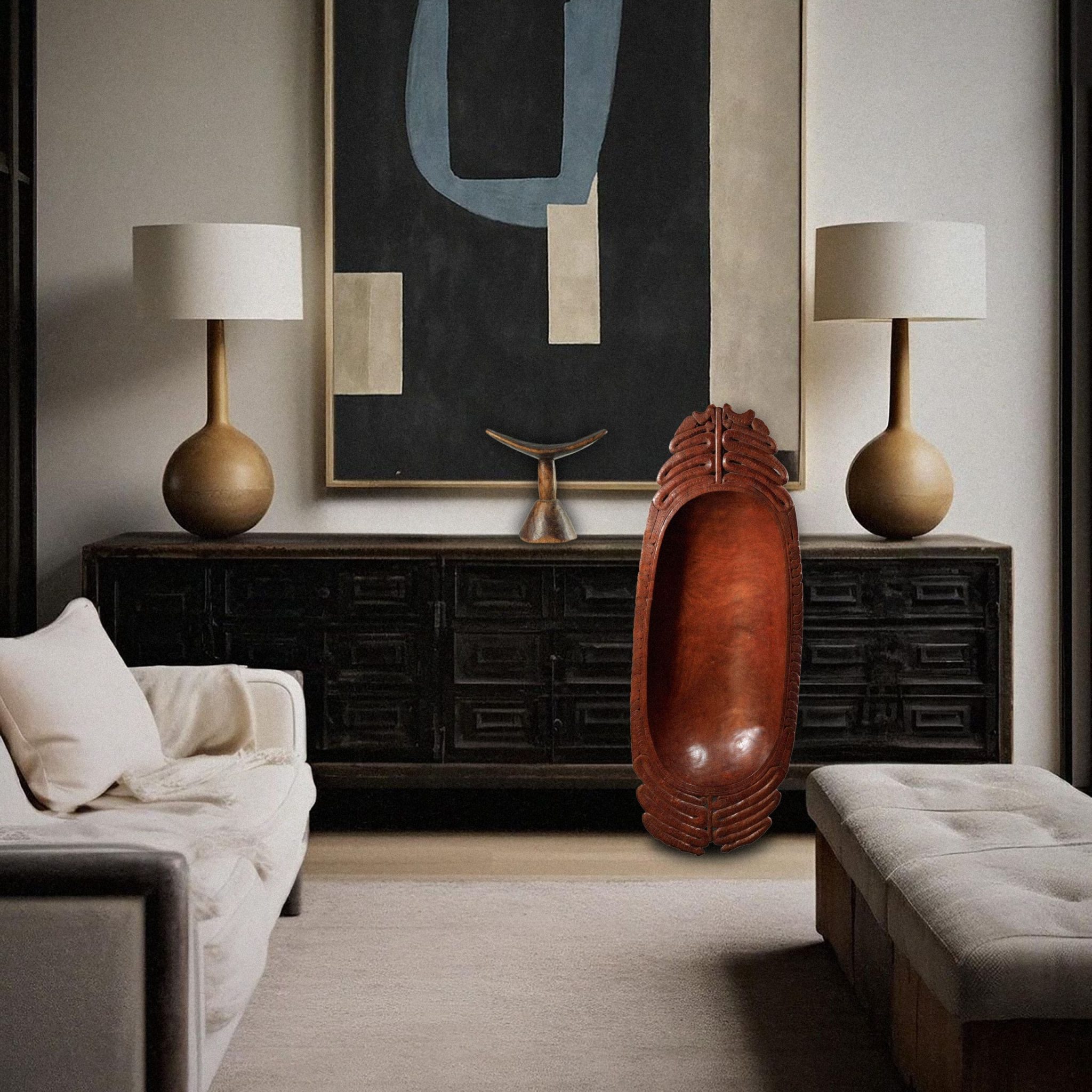
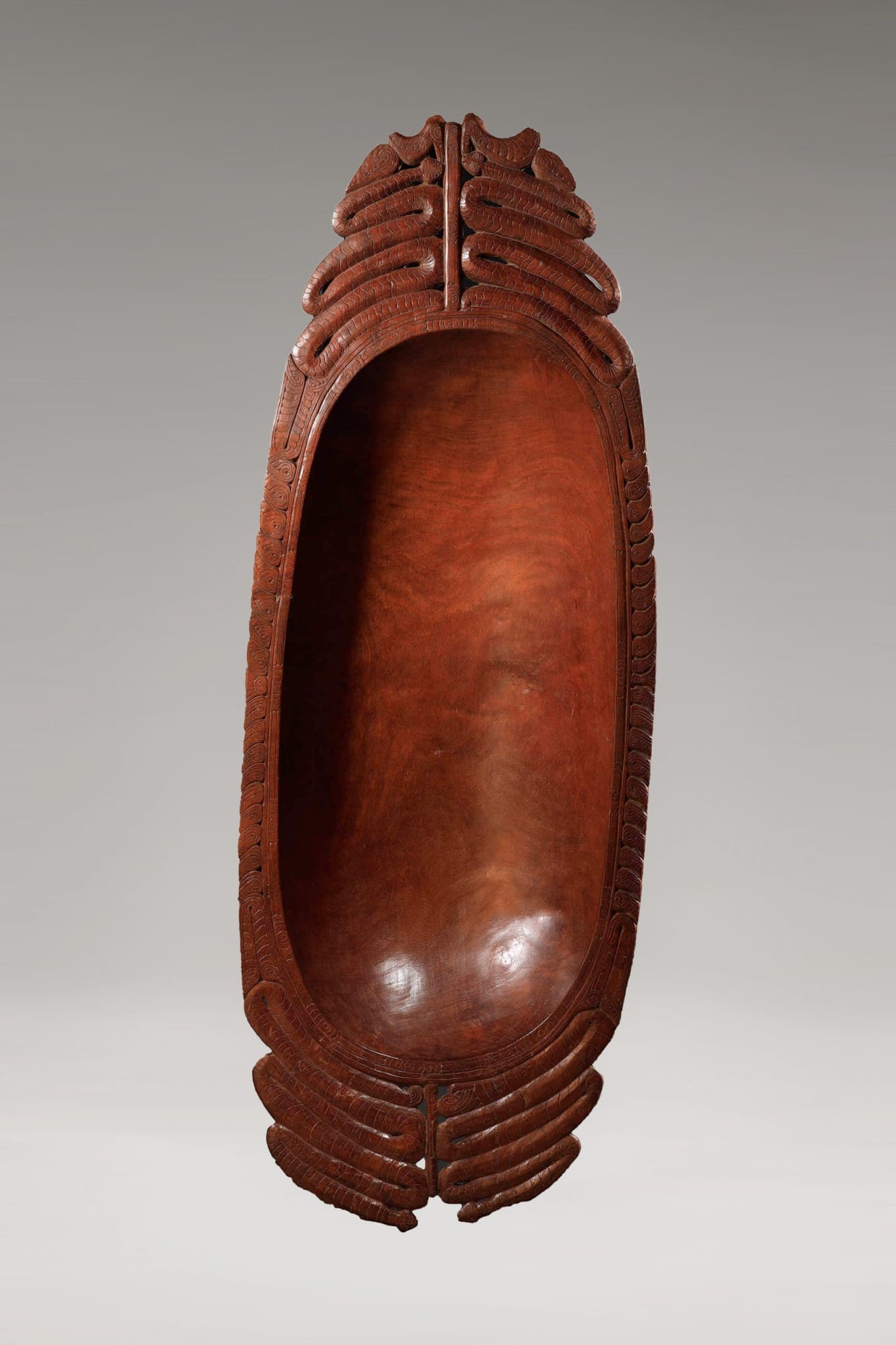
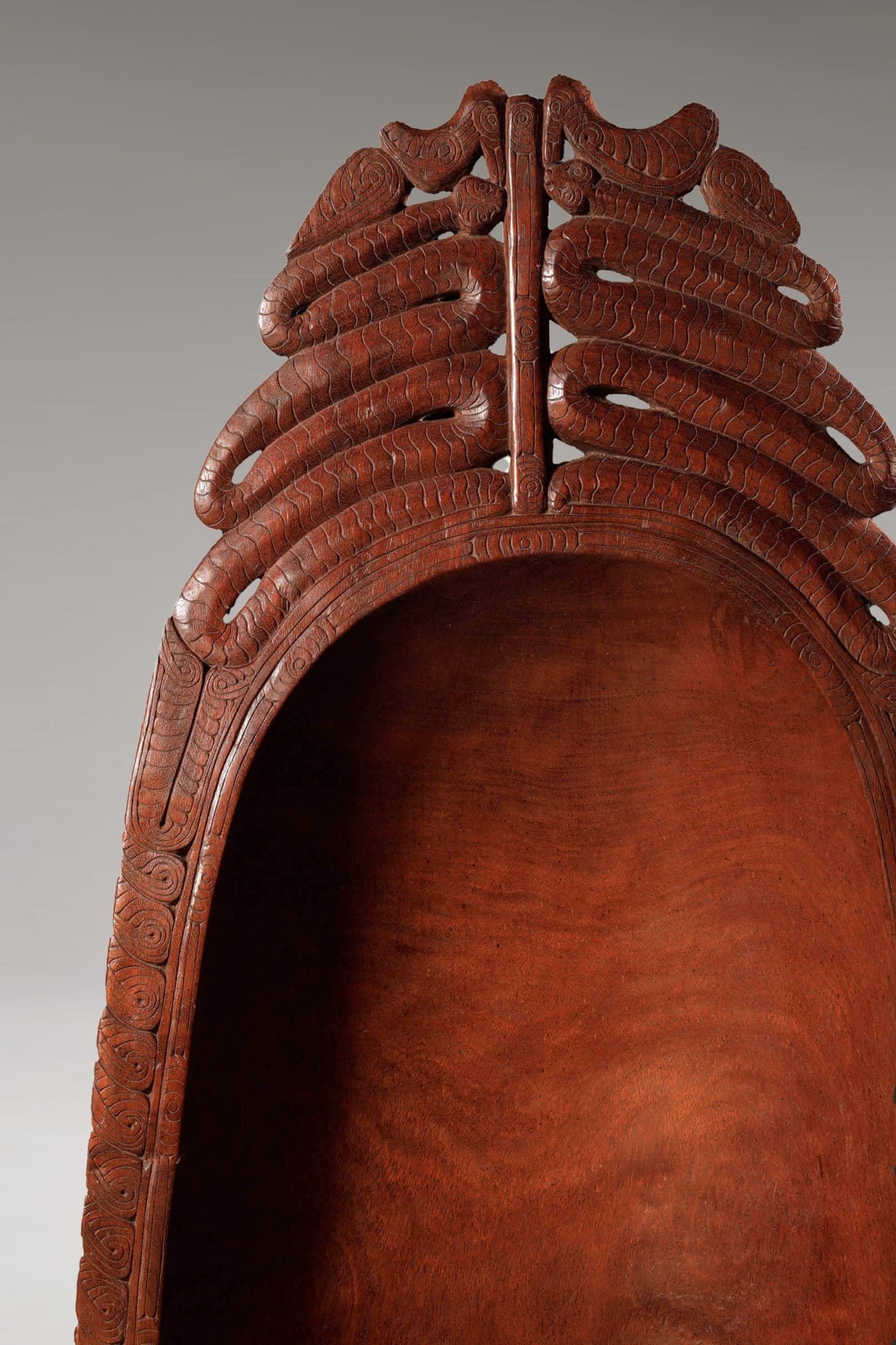
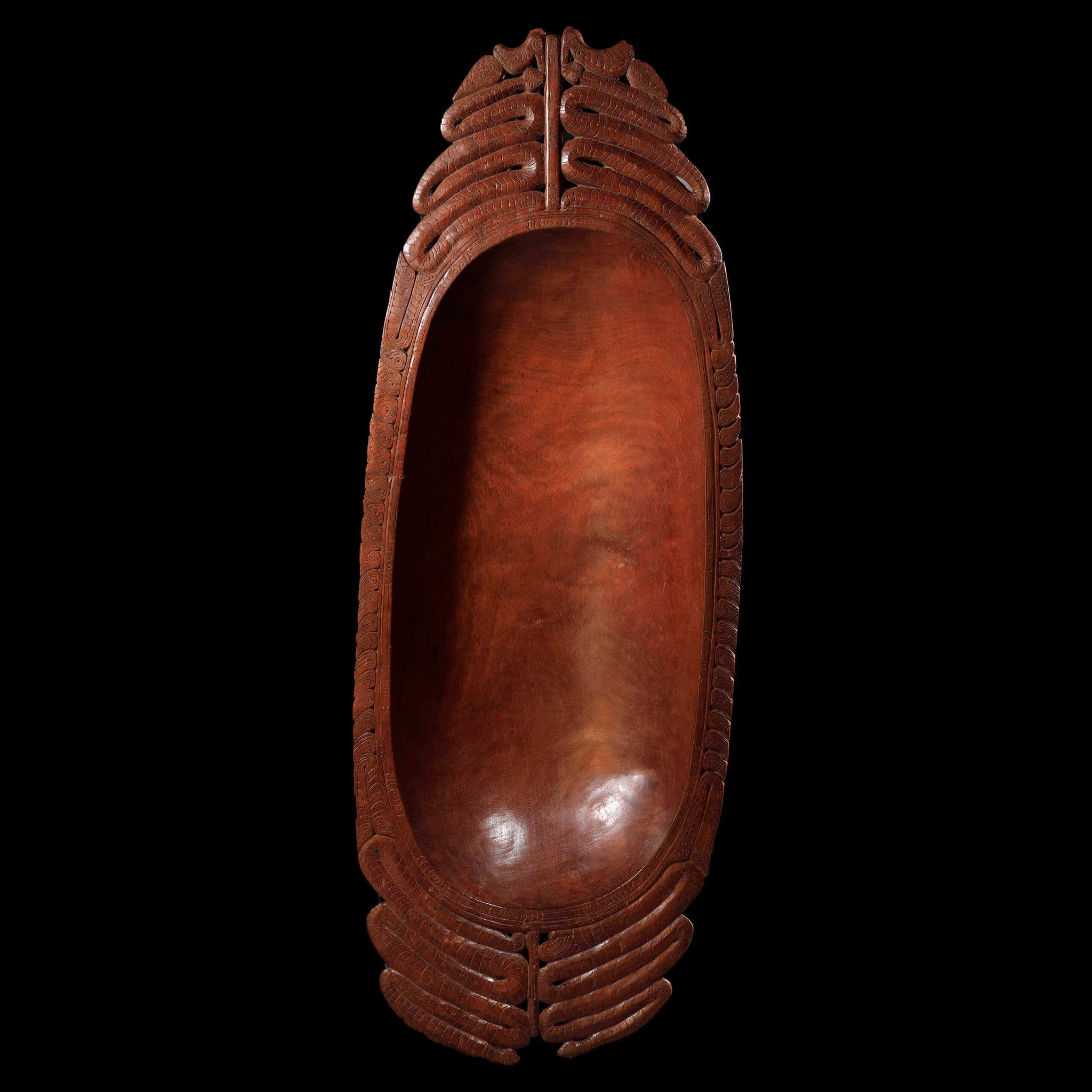
Trobriand carving is immediately recognisable to those familiar with Pacific art. Its characteristic vocabulary — dense, interlocking spirals, geometric border patterns, and curvilinear fields that reference canoe prow and yam house decorations — creates a surface texture that is simultaneously ordered and exuberant. This large tray, at 117 centimetres in length, provided its maker with a substantial canvas. The carved surface of a Trobriand object was understood to carry aesthetic power — the Kiriwina term megwa refers both to the spell sung over a canoe or a yam garden and to the visual beauty of a well-carved surface. These were not simply distinct categories: beauty was a kind of magic, and the care taken to incise a pattern precisely and completely was itself an act of efficacy, not mere ornamentation. A tray of this scale would have appeared at important feasts — harvest celebrations, mortuary distributions, or the great sagali exchanges that punctuated Trobriand ceremonial life — where food and objects were publicly given and received in quantities that established social standing.
An Object That Carries Its World With It
This Trobriand ceremonial tray represents a tradition of wooden object-making that has attracted sustained scholarly and collector attention since the early 20th century. The Trobriand Islands remain inhabited, their communities maintaining living versions of many of the traditions Malinowski described — modified, evolved, and engaged with contemporary realities, but recognisably connected to the world this tray was made in. To handle an object of this scale and quality is to engage, across the full distance of culture and time, with the aesthetic and social intelligence of the Kiriwina carvers who produced it: people for whom the quality of what they made was never a secondary consideration.

 No products in the cart.