

The Ashtray as Vanitas Object
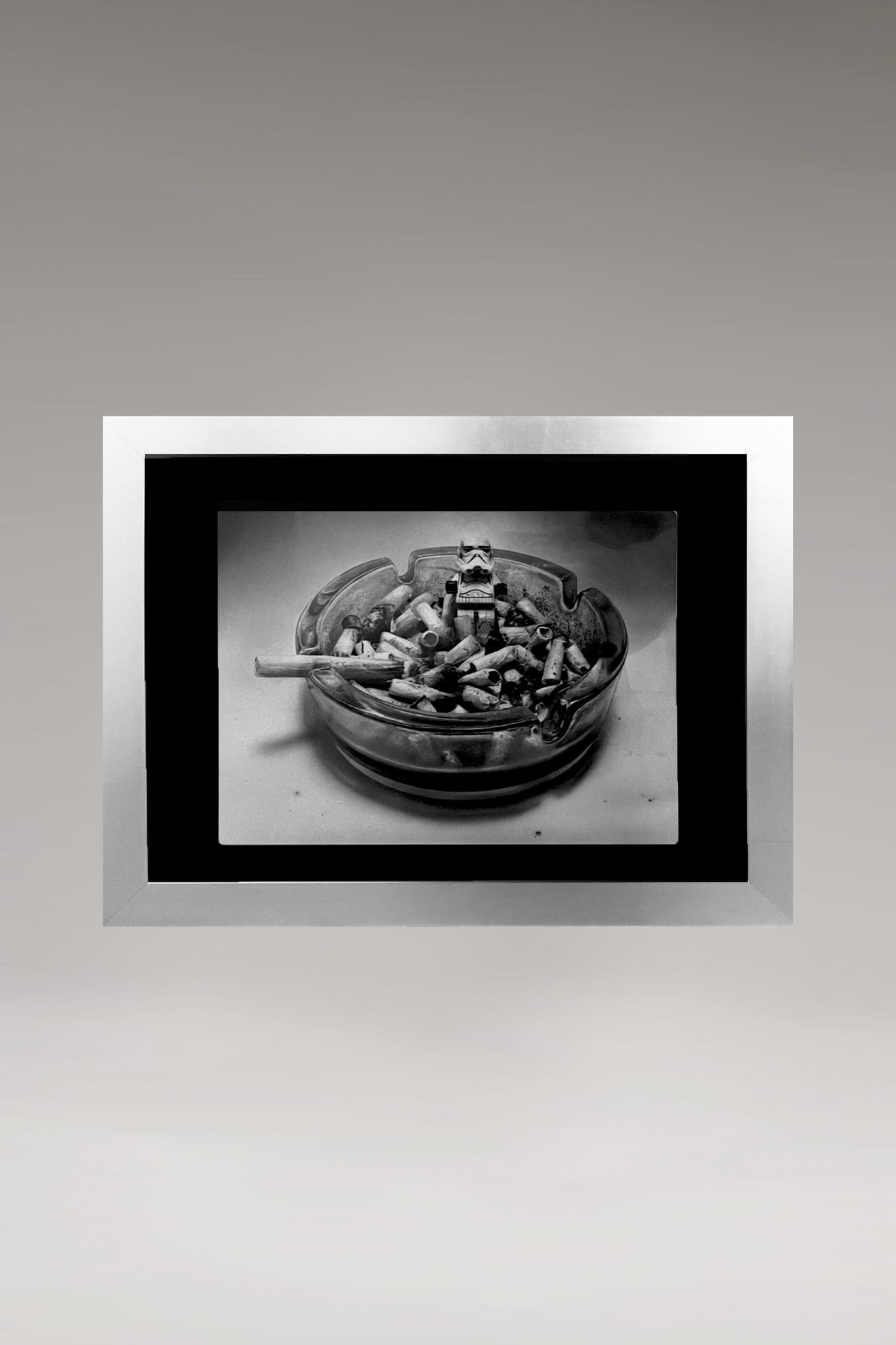
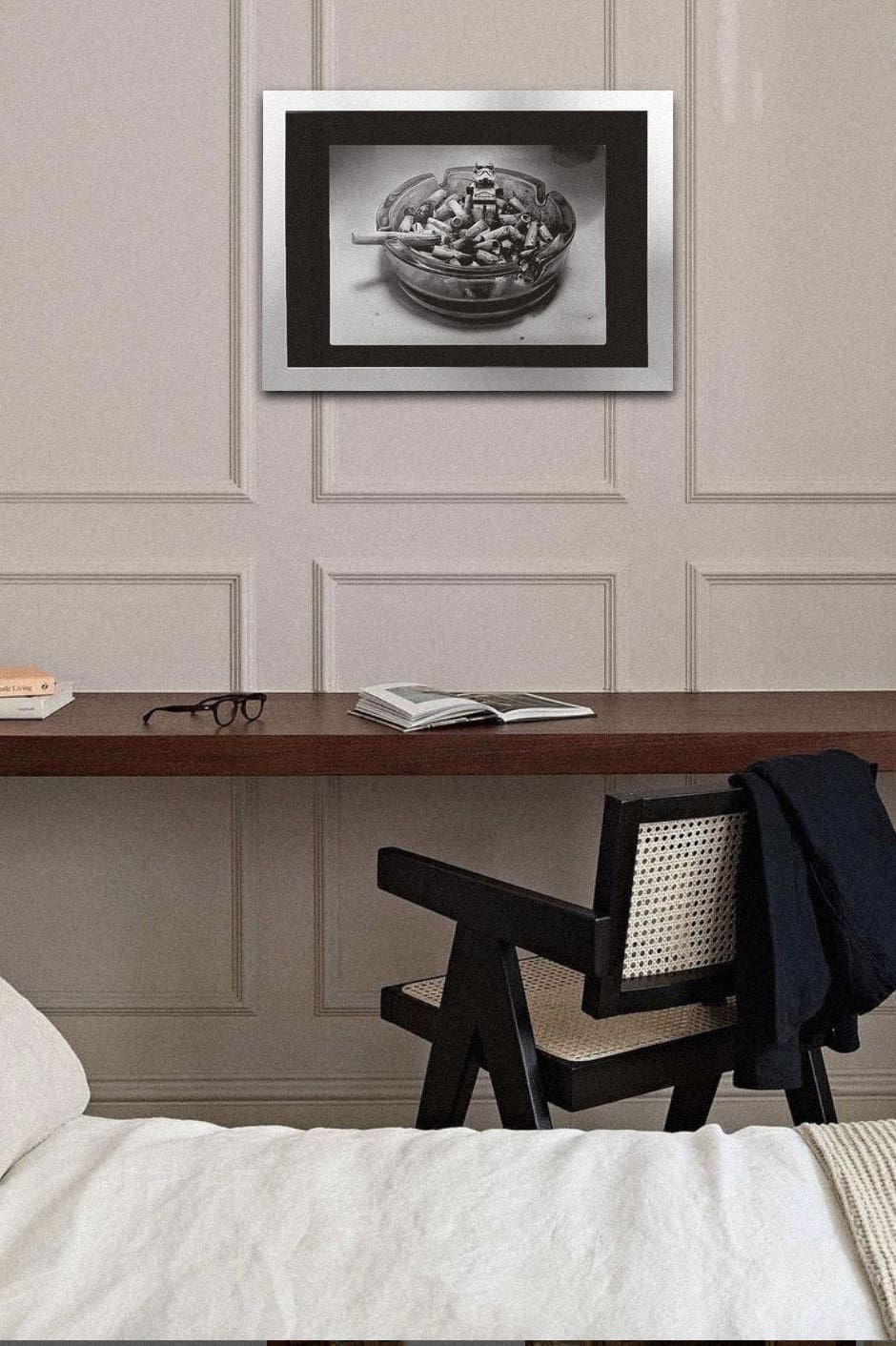
The ashtray is one of the 20th century’s most loaded domestic objects. Present on every café table, every hotel desk, every creative studio and family sitting room for most of the century, it accumulated a weight of cultural association — with pleasure and addiction, with sociability and solitude, with the slow consumption of time measured in ash and cigarette ends — that has given it, as the habit it served has retreated, a retrospective poignancy. The ashtray as a still-life object carries something of what the 17th-century skull carried: the evidence of use, the accumulation of small ends, the visible record of time passing through a specific body in a specific place. Luis Feo places this object alongside the Stormtrooper helmet — blank, anonymous, mass-produced, iconic in the contemporary sense that has nothing to do with individuality — and allows the two to address each other across the white space of the paper. The conversation they hold is about use and non-use, about the particular and the generic, about things that bear the marks of living and things designed to efface every such mark.
Graphite and Airbrush: A Hybrid Technique
The combination of graphite and airbrush in a single work on paper brings together two fundamentally different modes of mark-making. Graphite is indexical — every stroke records a contact between tool and surface, a specific movement of a specific hand. Airbrush is its apparent opposite: a tool that disperses pigment in a fine mist, smoothing transitions and eliminating the trace of the individual gesture, producing surfaces of photographic continuity and impersonal precision. In “Ashtray and Stormtrooper,” this technical pairing carries conceptual weight: the objects depicted — one bearing the traces of use, one designed to be perfectly smooth and anonymous — find their formal equivalent in the techniques used to render them. Feo’s fluency across both modes, and his ability to integrate them into a coherent surface, demonstrates a technical command that places him within the tradition of Spanish draughtsmanship at its most exacting.
Collecting Contemporary Spanish Drawing
The tradition of Spanish drawing — from Goya’s preparatory sketches to Picasso’s notebooks to the graphic works of Miró and Tàpies — is one of European art history’s richest and least systematically collected chapters. Contemporary Spanish artists working in drawing and works on paper occupy a position of particular opportunity: they inherit this tradition while working in a market that has consistently undervalued works on paper relative to painting and sculpture. Luis Feo’s Stormtrooper series represents a body of work that is both formally rigorous and conceptually coherent — qualities that support sustained collector attention. At a scale and format suited to domestic display, and produced in a medium that travels and stores without the fragility of canvas, “Ashtray and Stormtrooper” is also a practical acquisition: a work that asks to be lived with, its quiet still-life conversation continuing daily in whatever room receives it.
 No products in the cart.