

The Ceremonial Mask Traditions of the Gulf Province
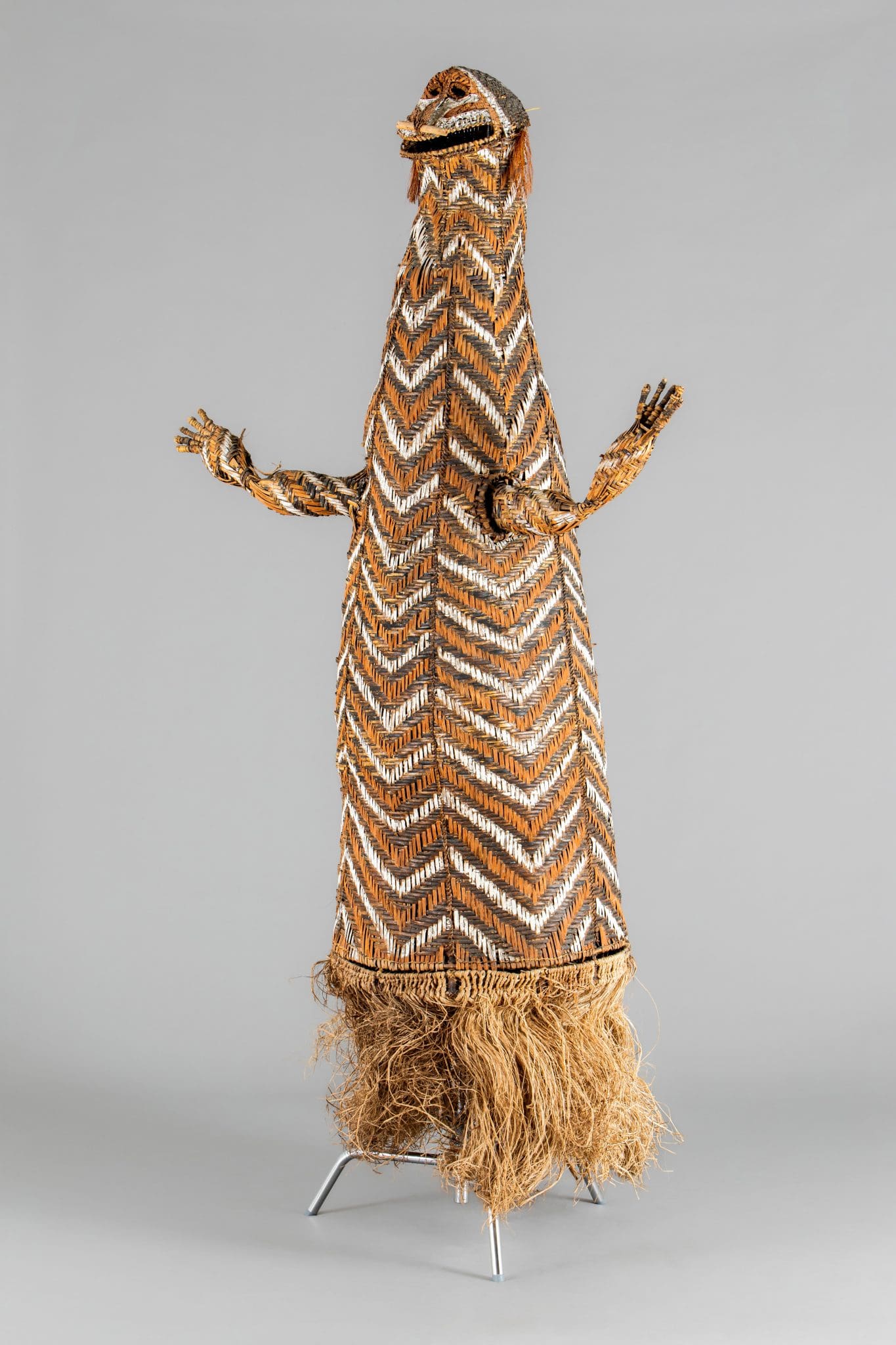
The Gulf Province of Papua New Guinea — extending along the northern shore of the great bay that gives it its name, drained by the Purari, Kikori, and Urama rivers — was home to some of the most extraordinary ceremonial traditions in all of Melanesia. The peoples of this region, including the Elema and the various groups settled along the Urama River, organised their social and spiritual lives around a cycle of initiatory performances in which large woven masks played a central and transformative role. These masks, sometimes reaching several metres in height, were the material embodiments of spirit beings who emerged from the men’s ceremonial house after years of preparation, dancing before the community before being ritually destroyed at the climax of the ceremony. The woven body mask presented here, collected in the field by the collector Rudi Caesar around 1970, belongs to this tradition of ceremonial performance, its large format — 156 centimetres in height — placing it among the most imposing examples of Gulf Province weaving in European private hands.
Weaving as Ritual Technology
The construction of this mask demonstrates the technical mastery that Gulf Province communities brought to the art of ceremonial weaving. Plant fibres — selected, processed, dyed, and interlaced with rattan and wickerwork — are assembled into a rigid three-dimensional form capable of supporting the weight of costume elements and the physical demands of sustained ceremonial performance. The palette of white, brown, and orange, produced from locally available mineral and vegetable dyes, carries symbolic weight within the ceremony: these colours relate to ancestral beings, specific clans, and particular phases of the ritual cycle, encoding meaning at every level of the object’s surface. At 156 centimetres in height and 54 centimetres in width, the mask would have covered the upper body of its wearer, transforming the human performer into a non-human presence — a spirit made visible through the combined technologies of weaving, pigment, and dance. The depth of 11 centimetres indicates a relatively flat, shield-like profile consistent with the body mask typology, designed to be seen frontally against the movement of the performer.
Field Collection and European Provenance
The provenance of this mask — collected in origin by Rudi Caesar around 1970, subsequently acquired at Bilbao Auctions in 2024 — places it within a specific and historically significant moment in the relationship between Western collectors and Melanesian ceremonial art. The late 1960s and early 1970s represented the last period in which it was possible to acquire major ceremonial objects directly in Papua New Guinea before Independence (1975) and the tightening of export regulations that followed. Objects collected in this window carry a documentary value beyond their aesthetic appeal: Caesar’s field collection establishes a solid provenance chain and grounds the mask in its original geographic and cultural context with a specificity that later-appearing pieces cannot match. For collectors of Oceanic art, this Dance-Body Mask offers a rare combination of impressive scale, technical quality, excellent conservation, and documented provenance.


 No products in the cart.